When essential operations cannot stop, effective bed bug management requires more than a treatment. It requires detection, the right technology, continued monitoring and employee confidence.
A November 21, 2026, New York Post report about bed bugs at New York City’s 911 call center highlights a challenge that many commercial buildings and essential facilities face: what happens when bed bugs appear in a workplace that cannot shut down?
According to the report, employees have taken precautions such as covering chairs in plastic and bagging personal belongings. The city has reported progress in addressing the problem, but employees remain concerned.
We cannot speak to the specifics of the city’s pest management program. However, the situation illustrates an important principle: successful bed bug control means both eliminating the insects and giving employees confidence that their workplace is being protected.
At Bell Environmental, we have encountered this challenge in hospitals, ambulances, public safety vehicles, call centers and other continuously occupied environments.
The good news is that an entire facility does not necessarily need to close to address a bed bug problem. And treatment options exist that can address bed bugs immediately, without forcing room closures, damaging furniture and equipment, or forcing owners to throw out furniture while preserving employee health and ability to work.
Start by finding the bed bugs
Bed bugs are difficult to control when their locations are uncertain.
They may hide in upholstered furniture, seams, cracks, crevices and other protected spaces near where people spend extended periods.
In a busy workplace, visual inspections may be supplemented with trained bed bug detection dogs and strategically placed monitoring devices.
The goal is to identify where activity exists, determine the appropriate treatment areas and establish a basis for evaluating progress.
Inspection is not a one-time event. Continued monitoring helps determine whether an infestation has been eliminated or whether additional bed bugs have been introduced.
Treat the infestation without unnecessarily interrupting operations
Traditional bed bug treatments can present challenges in environments containing sensitive electronics, upholstered furniture, medical equipment and people who cannot easily be relocated.
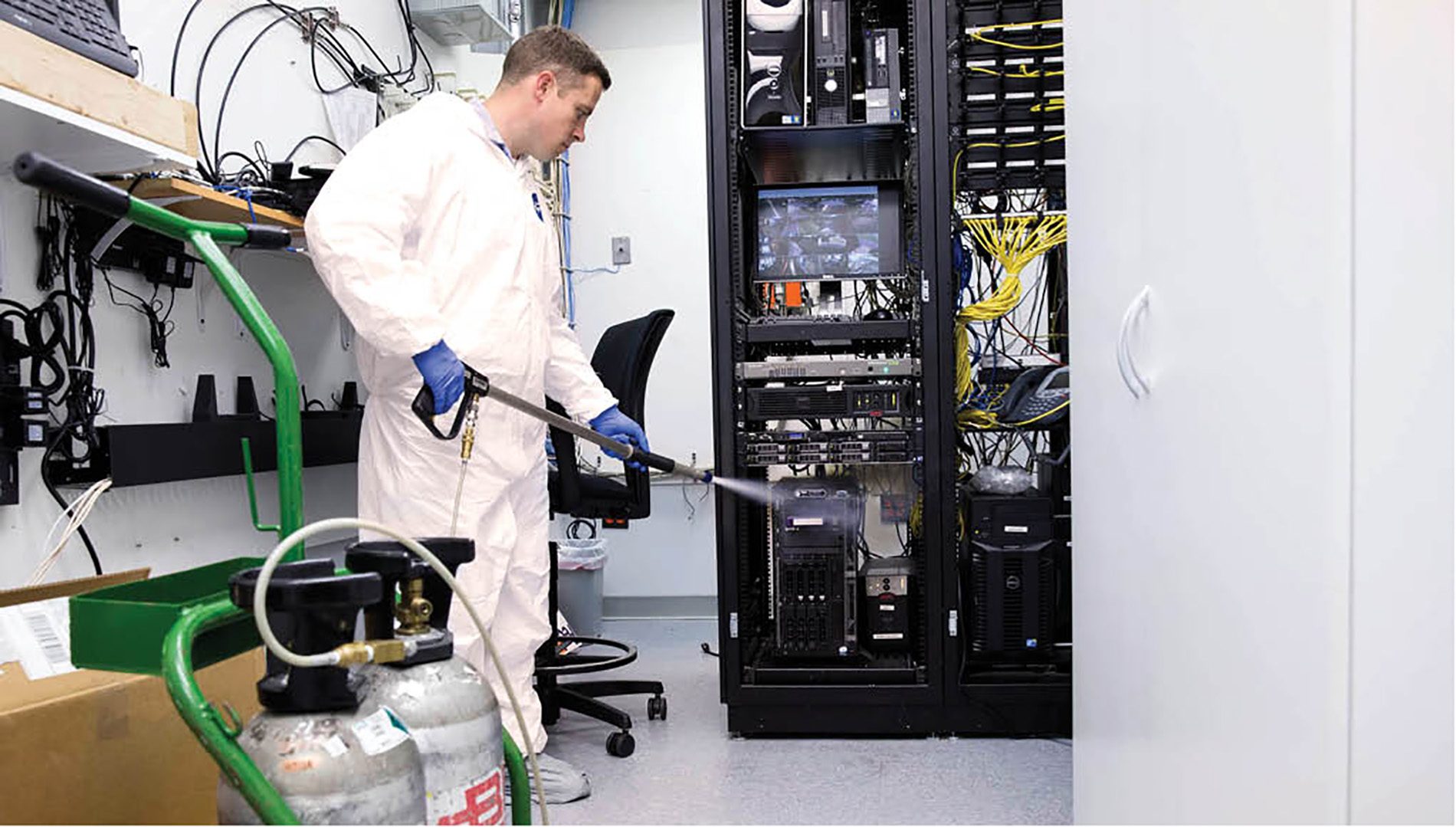
Bell Environmental’s InstantFreeze® technology uses carbon dioxide to kill bed bugs through rapid freezing on direct contact.
This provides several important advantages in suitable applications:
- Bed bugs can be killed immediately when directly exposed to the treatment.
- Furniture, seams, cracks and other accessible hiding places can be treated.
- Appropriate areas near sensitive equipment may be addressed without applying conventional pesticide residues.
- Individual rooms, furnishings or vehicles can often be treated without requiring an entire facility to shut down.
- The method does not depend on leaving a conventional insecticide residue behind.
Treatment around electronics and other sensitive equipment must still account for equipment specifications, moisture and condensation risks, and operational safety requirements.
Carbon dioxide freezing is not a residual treatment. It kills the insects it reaches, but it does not provide ongoing protection against bed bugs that escape treatment or are subsequently introduced.
That is why effective bed bug management combines treatment with careful inspection, follow-up and other control methods when appropriate.
Does a bed bug infestation require fumigation?
News reports frequently use the word fumigation as a general term for pest control treatment.
Technically, fumigation is a specific process involving the use of a gaseous fumigant under carefully controlled containment and safety conditions. Pest control companies and their employees need specific licenses to be able to perform fumigation services, and manufacturers reinforce licenses with specific training and onsite inspection and set up services.
Fumigation is not synonymous with spraying, freezing, steaming or other methods of treating bed bugs.
True fumigation may have applications in certain circumstances under the right safety conditions, but it is generally not a practical solution for treating one section of an occupied office building or a continuously operating emergency communications center.
Fortunately, there are other methods available.
The appropriate treatment depends on the infestation, the physical environment, the equipment involved and the operational requirements of the facility.
Employees need confidence, not just reassurance
A workplace can be treated successfully and still leave employees anxious. The anxiety spreads once there is a report of bed bugs, and we get questions of is whatever may be seen on sight is believed to be a bed bug. That flying insect (not a bed bug) but the employee fears it is.
Bed bugs can create considerable stress. Employees may worry about being bitten, bringing insects home or encountering another infestation.
Simply announcing that a treatment has been completed may not resolve those concerns.
A thoughtful pest management program should include clear communication about what has been inspected, what treatment has occurred, what monitoring continues and what employees should do if they encounter another insect.
Not every insect sighting is a bed bug, and not every report indicates an ongoing infestation. Prompt identification and investigation help distinguish actual activity from understandable anxiety.
Follow-up inspections are evidence of diligence, not necessarily evidence that a treatment has failed.
Employees deserve both effective pest control and credible information about what is being done to protect them.
What if bed bugs are (repeatedly) introduced by an employee?
This is the elephant in the room. Bed bugs are hitchhikers. They can travel on clothing, bags, personal belongings and furniture from any infested environment.
Their presence is not evidence of poor housekeeping, and identifying a source should never become an exercise in embarrassing or blaming an employee.
Sometimes a workplace infestation is connected to an unresolved bed bug problem in someone’s home. It’s rare that an employee reports trouble to his bosses. And the employer could have employees turn around and state that they (truthfully or falsely) got bed bugs from the office
In those situations, a discreet, voluntary offer of assistance may be one of the most effective long-term solutions.
An employer might help connect an employee with a qualified pest management professional for an inspection and more, or offer appropriate financial assistance for treatment at home, while respecting privacy and applicable employment requirements.
There are also a practical business considerations.
Repeated inspections, treatments, disruptions and employee concerns can cost substantially more than helping resolve the source of recurring introductions. Solving the issue in one employee home lessens the risks and costs in the workplace, and helps protect other employees from bites in the office and taking these pests home.
Compassion and sound facilities management are not competing objectives.
Keep essential services operating
Hospitals cannot stop caring for patients. Emergency dispatchers cannot stop answering calls. Ambulances, police vehicles and fire apparatus cannot simply be removed from service indefinitely.
These environments require pest management strategies designed around operational continuity.
At Bell Environmental, our approach is to identify the problem, select appropriate treatment methods, minimize disruption and continue monitoring until the evidence supports that the infestation has been resolved.
No single technology is appropriate for every situation. But a well-designed program can often address bed bugs without extensive shutdowns or unnecessary disruption.
The real measure of success
Eliminating bed bugs is the technical objective.
Restoring confidence is the human objective.
Both matter.
When employees know that management is actively working to maintain a bed bug free environment, using effective treatment methods, responding to concerns and following up, they have a stronger basis for feeling secure in their workplace.
And when those employees are responsible for protecting public health and safety, that confidence becomes even more important.
Essential workplaces should not have to choose between controlling bed bugs and continuing to serve the public.
Bell Environmental Services provides commercial pest management programs, including canine bed bug detection, InstantFreeze® carbon dioxide treatment and integrated pest management services throughout the New York metropolitan area.
Related reporting: New York Post, November 21, 2026