June Transportation Report: Summer Escape Has Fine Print 🚆🌊🍹
A summer sendoff from the BOMA transportation desk
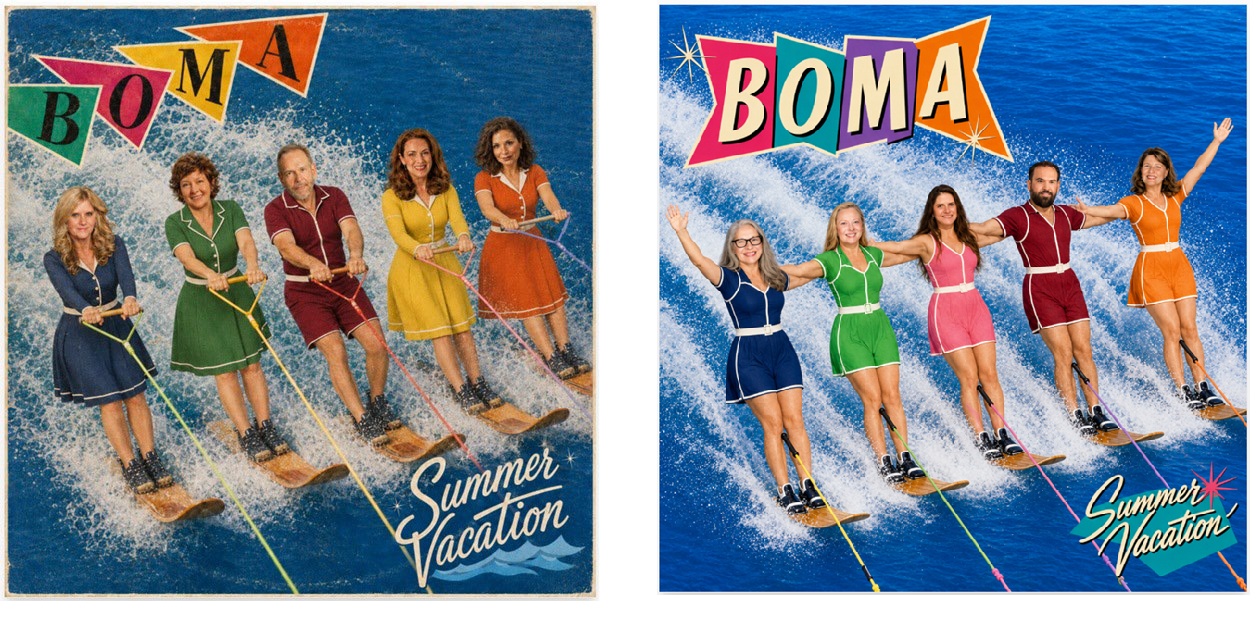
We all earned a summer vacation. With strong drinks and a New Wave soundtrack!
First about the report (album) covers! We’re so grateful to the teams who run our BOMA chapters, with thought it was time to feature the leadership’s smiling faces on our report covers.
Thanks To Sharon, Bridget, Ed, Carolina, + Lori and team for all they do in NYC. Thanks also to Connie, Tina, George, Amanda + Heather and the Alta team for fantastic NJ experiences. To quote Fast Times At Ridgemont High’s Jeff Spicoli, “All I need are some tasty waves, a cool buzz, and I’m fine.” We’re stoked and think you deserve time on the water and new wardrobes, and a bitchin’ soundtrack playing in the background for a Rad Summer.
The rest of us deserve a real break too! Sunshine. The beach. Waves. Tropical drinks. Great music. Maybe even a few days when nobody has to ask whether the train is delayed, the tunnel is open, the flight is on time, or the parking lot is sold out.
But this year, as the June 2026 BOMA Transportation Report makes clear, escape has fine print.
The latest report is now available in two versions:
Read the BOMA-NYJune 2026 Transportation Report here. And/or read the BOMA New Jersey June 2026 Transportation Report.
Both versions share the same regional transportation spine, but each has its own local cover and personality,. The New York version opens with BOMA NY leadership in a retro summer-album spirit. The New Jersey version brings the same summer escape energy home with BOMA NJ leadership, Jersey beaches, slices, diners, and the long way home. Instead of hyperlinks as part of the text this issue, we sourced with extensive endnotes.
The big idea: We All Earned Summer Escapes, but the small print has gotten in the way of any break.
Summer transportation is supposed to be about getting out.
Flights. Ferries. Shore weekends. Trains. Long drives. Ballgames. Parks. Diners. Airports. Beaches. Maybe even a perfectly timed song when you finally get where you were trying to go.
But the June issue looks at the details that keep complicating the getaway:
- World Cup transportation planning at MetLife Stadium
- Penn Station redevelopment
- NJ Transit and Amtrak fragility
- Gateway and Hudson tunnel redundancy
- High gas, jet fuel, and travel costs
- Newark Airport and AirTrain issues
- Street, bus, curb, ferry, and stormwater updates
- Local NY and NJ summer escapes
- A few visual detours, because even transportation people need a break
That is the heart of the issue: everyone is trying to get somewhere else, but the route keeps pushing back. As you read the report you’ll also see some great album covers, reinvented to reflect the report’s transportation bent. Hope you enjoy the virtual soundtrack of The Go-Gos, Bruce Springsteen, Men At Work, The Beastie Boys, Duran Duran, ZZ Top and more on an old Walkman, as you peruse this beach read.
World Cup transportation: getting to the match may be its own event ⚽🚍🚆
The June report opens with a detailed look at World Cup transportation planning for MetLife Stadium.
Rail tickets, shuttle buses, private-car limits, rideshare rules, American Dream parking, Midtown security zones, and special NYC bus plans all point to the same challenge: moving World Cup crowds in a region that already has very little room for error.
One of the most interesting contrasts in the issue is the “why see the World Cup when you can see the world?” idea, inspired by airline marketing that compared the high cost of attending World Cup matches with the lower cost of flying to some of the countries playing in them.
It is a clever ad idea, but it also makes a serious transportation point: the price of escape has become part of the story.
Fuel is still the fine print ⛽✈️
The report also looks at something travelers feel even when they stop talking about it: fuel costs.
Getting used to higher fuel costs has not made them cheaper, or made the public any happier.
Gasoline affects drivers. Jet fuel affects airlines. Diesel affects deliveries, construction, trucking, and operating costs. Higher fuel costs show up in airfares, travel decisions, business margins, and the everyday cost of moving people and goods around the region.
Summer travel may still be happening, but the cost of getting away is dividing travelers into those who can absorb higher prices and those who are delaying, downsizing, or skipping trips altogether.
Penn Station is trying to escape being Penn Station 🚉
The main feature of the June issue is Penn Station.
The key line:
Even Penn Station is trying to escape being Penn Station.
That has been the dream for decades: escape the low ceilings, the maze, the platform crush, the dead ends, the “pit,” and the feeling that the busiest rail hub in the country was designed around everything except the people trying to use it.
The new Penn Station redevelopment plan promises more light, more space, more vertical circulation, fewer platform columns, reopened connections, and a stronger station entrance. Those are real improvements if they happen.
But the report also asks the questions that matter to property owners, managers, tenants, commuters, and regional leaders:
Who pays?
Who controls the project?
Who captures the real estate value around the station?
How does Madison Square Garden staying in place limit the rebuild?
How does Amtrak ownership affect NJ Transit and LIRR riders?
How does Gateway fit into the same regional problem?
Can Penn actually move people better, or just look better in renderings?
The report treats Penn not only as a station project, but also as a real estate project, a neighborhood project, a governance project, and a public-finance project.
That is why the business of Penn Station matters. The area around Penn, Hudson Yards, Manhattan West, and the Penn District has become one of the most important commercial real estate stories in the region. If public infrastructure creates private value, the public deserves a clear answer about cost, control, benefit, and accountability.
Penn is not just crowded. It is brittle.
Late May made the Penn problem hard to ignore.
Falling concrete that struck an NJ Transit train’s pantograph and a separate Amtrak contractor-equipment fire near the Hudson River tunnel approach disrupted NJ Transit, Amtrak, and LIRR service.
The incidents were separate, but together they made the larger point:
Penn is not just crowded. It is brittle.
And Gateway is not a future luxury. It is the backup plan the region does not yet have.
A rebuilt Penn without Gateway would still feed into a fragile river crossing. Gateway without a more functional Penn would still deliver trains into a station that struggles to process people. The projects are different, but they answer the same regional problem: New York and New Jersey cannot keep adding commuters, visitors, events, and expectations onto a system with so little room for failure.
A serious issue with an 80s soundtrack 🎶
The June report is dense because the news is dense. But it was designed to breathe.
The issue uses a summer soundtrack, retro album-cover energy, visual transitions, and local escape pages to keep the report readable. The album-cover jokes are not there just to be funny. They create a lighter frame around serious transportation news.
The idea is simple: readers can absorb more policy when the pages give them space, rhythm, and a few reasons to smile.
This is still a transportation report. But it also has a little Go-Go’s, a little Eagles, a little Springsteen, a little Sinatra, and one final drink with Harrison Ford.
Local escapes: subway, park, diner, booth 🌳🚇🍽️
The BOMA – New York version includes small city escapes: a musician playing Bach in the subway, Katz’s upstairs room, Puerto Rico in Madison Square Park, and a childhood detour toward the Jim Henson Creature Shop.
The New Jersey version puts Jersey first: the Shore, slices, disco fries, NJ Transit’s Pizza & Pints map, and the diner booth.
One of the favorite lines in the issue:
If Penn is where escape gets trapped, the Jersey diner is where escape slows down on purpose.
Diners are not just nostalgia. They are relationship infrastructure. They are where business conversations, vendor relationships, friendships, lunch meetings, and Jersey anthropology still happen across a table.
For BOMA NJ, that matters.
Harrison Ford gets the last drink 🥃
Harrison Ford has become an unofficial recurring figure in the Transportation Report universe: the patron saint of cursed infrastructure, tunnel escapes, bad systems, and impossible routes home.
So the June issue ends with a nod to Raiders of the Lost Ark:
“Come on. I’ll buy you a drink.”
After Penn Station, World Cup logistics, fuel prices, stormwater, air travel, ferries, sinkholes, and service disruptions, the report closes with the simplest version of escape: getting where you were trying to go, opening the door, and stepping out at the right moment in the song.
Even Indiana Jones might wonder whether escaping Penn Station is harder than escaping the Temple of Doom.
Read the June 2026 Summer Escape Issue!
Read the BOMA-NYJune 2026 Transportation Report here.
Read the BOMA-NJ June 2026 Transportation Report here.
Whether your summer escape is a flight, a ferry, a Shore weekend, a subway ride, a diner booth, or just one quiet moment away from the schedule, the June report is a reminder that transportation is never just about movement.
It is about cost, access, reliability, design, public space, real estate, politics, weather, infrastructure, and the daily hope that the route cooperates.
Hope you get to make your great escape and celebrate summer your way. 🌞


